Levan Book Chat-Ciruce Movahedi-Lankarani-Accelerant
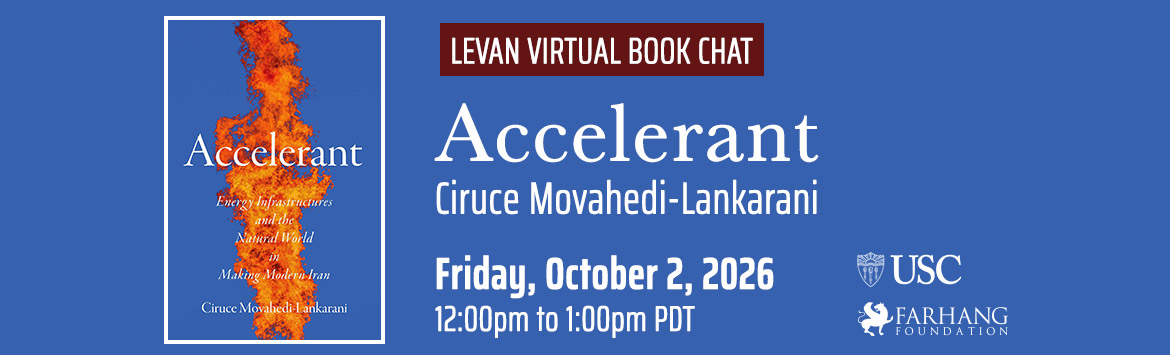
Levan Virtual Book Chat
Accelerant
Energy Infrastructures and the Natural World in Making Modern Iran
October 2, 2026 - 12pm
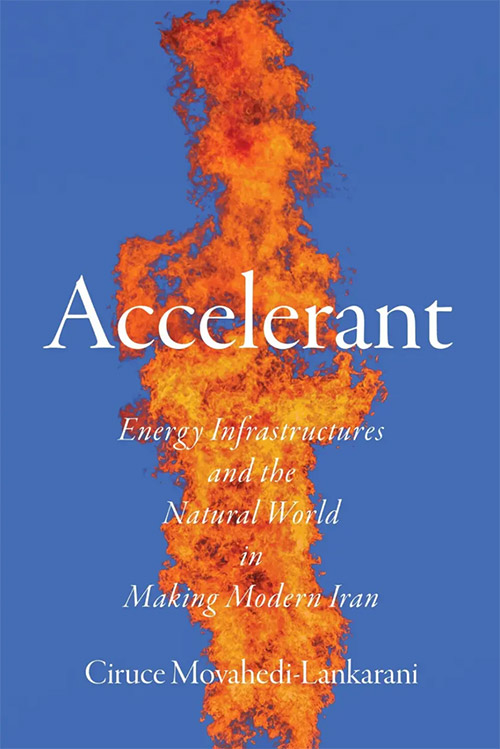
An online discussion of Ciruce Movahedi-Lankarani's new book, Accelerant: Energy Infrastructures and the Natural World in Making Modern Iran (Stanford University Press, 2026). The author will be joined in conversation by Arang Keshavarzian (NYU) and Victor Seow (Harvard University), moderated by Joanne Nucho (USC). Organized in partnership with the USC Department of Middle East Studies, USC Environmental Studies Program, and Farhang Foundation.
About the Book: Between the late 1940s and the end of the twentieth century, natural gas became Iran's bedrock energy source. Billed as a futuristic fuel for a future world power, gas became an avenue for the country's developmentalist ambitions. The ability to build technologically sophisticated infrastructures served as a powerful tool of state legitimation, both before and after the 1979 Revolution, and tied top-down politics of modernization to bottom-up feelings of national belonging.
Accelerant analyzes the interwoven histories of energy, development, and the environment in Iran. Following the movement of natural gas from underground deposits, through infrastructures of refining and distribution, and into everyday life, Ciruce Movahedi-Lankarani explores the roles of development planners, oil firms, industrialists, engineers, and consumers—as well as the mountain ranges, sedimentary rock, and natural gas itself—to show how natural gas emerged as a crucial enabler of industrialization and a strong impetus for resource nationalism. Tracing the transformation of gas from a waste product into a vital resource, this book offers a history of anticolonial developmentalism in Iran—revealing a key driver toward intensified energy use that suggests why and how societies in the Global South became voracious consumers of fossil fuel energy.
About Ciruce Movahedi-Lankarani
 Ciruce Movahedi-Lankarani is the Farhang Foundation Early Career Chair in Iranian Studies and Assistant Professor of Middle East Studies and Environmental Studies at the University of Southern California. Ciruce studies modern Iran, focusing on the country’s recent history through the interwoven perspectives of technology, development, and the environment.
Ciruce’s first book, titled Accelerant: Energy Infrastructures and the Natural World in Making Modern Iran (Stanford: Stanford University Press, 2026), studies the history of natural gas in twentieth-century Iran. It follows the movement of the resource from underground reservoirs through infrastructures of refining and distribution into everyday life, in the process tracing the interconnections of development planners, oil firms, industrialists, engineers, consumers, mountain ranges, sedimentary rock layers, and natural gas itself. At the heart of the book is an exploration of how the material properties of Iran’s vast natural gas resources, Iran’s topography and geology, and the infrastructures used to exploit fossil fuels all influenced competing notions of progress, modernity, prosperity, and the environment in the country during a period of self-conscious modernization. Drawing upon perspectives in Middle Eastern history, energy history, science and technology studies, and political ecology, the book contributes to our knowledge of development in modern Iran, the creation of fossil fuel energy systems in the Global South, and the role of resource nationalism in the creation of intensive hydrocarbon energy regimes. By linking debates on environmental change to the politics of resource extraction in Iran, Accelerant sheds light on the sociopolitical significance of energy infrastructures in the creation of industrialized societies in the modern Middle East.
Ciruce’s second research project addresses petrochemicals and their place in the construction of industrialized lifeways and environments in Iran and the Global South. Eschewing the focus on energy and revenues that has marked much of the scholarship on petroleum, the project seeks to understand how Iranian petrochemicals have shaped both the country’s own development as well as those societies to which they were exported. More than an account of an industry and its political economy, I aim to shed light on the largely untold history of the petrochemical-saturated world we inhabit, studying how people in Iran and elsewhere have come to depend upon—even desire—industrialized cycles of life and death that are structured by petroleum-based fertilizers, plastics, and pharmaceuticals.
Reflecting the fact that Iran’s petrochemical industry was established with an explicit eye toward exports, with this project I aim to put the country at the center of a global framing that traces the streams of expertise, finance, and chemicals that have connected it to other regions. Such cross-border flows meant that petrochemicals’ shaping of Iranian lifeways occurred in conjunction with their influence in other societies, links that require a transnational viewpoint to understand. It is a perspective that not only accounts for the involvement of firms of wealthy states like the United States and Japan, but also the South-South connections that Iran’s petrochemical exports have formed with places like India, Turkey, and Tanzania. It further reflects my interest in considering Iran not as a peripheral supplier of oil in the construction of the modern world, but as an integral and influential part of global process that have led to the formation of contemporary societies.
Ciruce’s research reflects not only his interests in Iranian history and the environment, but also his training and professional experience in engineering. Through those experiences he developed an appreciation for peoples’ varied interactions with technology and his work seeks to explore the historically contingent ways they have encountered, adopted, adapted, translated, and rejected technologies in both practical and ideational terms. In emphasizing the environmental contexts in which such events were embedded, he studies how imaginaries of technology and the environment in the Global South have had and will have profound implications for people and societies in the region, humanity as a whole, and the natural world.
Ciruce’s work has been supported by the National Endowment for the Humanities and the Social Science Research Council.
Discover Ciruce Movahedi-Lankarani
 |
Event Details
| Event Starts | 10/02/2026 – 12:00 pm |
| Event Ends | 10/02/2026 – 1:00 pm |
| Individual Price | Free Event - Registration Required |
| Location | Online |